
On June 19, 2026, I visited the United Nations (UN) Office in Nairobi, Kenya. Through this visit, I once again realized that the UN Office in Nairobi is not merely a regional office, but has become an important strategic hub within the United Nations as a whole.

What is the United Nations, and What is the "UN Family"?
The United Nations was established in 1945 and currently has 193 Member States. Its three main objectives are:
- Maintaining international peace and security
- Promoting economic and social development
- Advancing human rights
In addition, through what is known as the "UN Family," the United Nations is not a single organization but is composed of numerous specialized agencies, funds, and programmes.
This structure enables the UN to operate globally across a wide range of fields, including development, the environment, and humanitarian assistance.

Nairobi: One of the Four Major UN Duty Stations
The United Nations has four major duty stations:
- New York (Headquarters)
- Geneva
- Vienna
- Nairobi
Among these, Nairobi is regarded as the third major UN hub, and its importance has grown rapidly in recent years.
In terms of staffing, New York and Geneva each have approximately 30,000 personnel, while Nairobi employs around 5,000 staff members, making it the next largest UN duty station.
Distinctive Features of the Nairobi Office: Combining Headquarters Functions and a Regional Hub
The UN Office in Nairobi possesses characteristics that distinguish it from the other UN duty stations.
- Global Headquarters Functions
Nairobi hosts the global headquarters of the following two UN organizations:
- UNEP (United Nations Environment Programme)
- UN-Habitat (United Nations Human Settlements Programme)
- Regional Hub Functions
At the same time, Nairobi serves as the hub for the African region, housing:
- Regional offices for Africa
- Country offices covering Kenya, Somalia, and other countries
This creates a multi-layered organizational structure.
In other words, Nairobi is distinctive in being both a “headquarters” and a “field office” at the same time.

The Nairobi Office Grounds and Its Design Philosophy
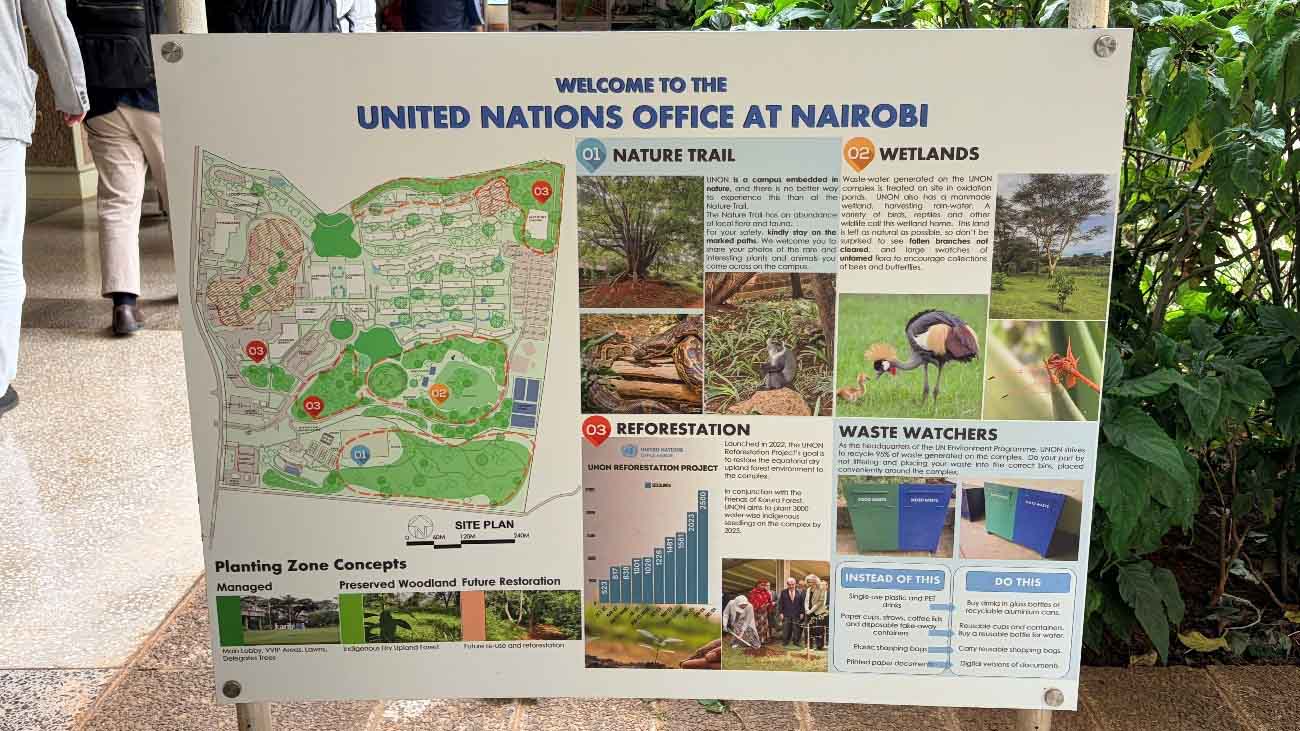
The UN Nairobi Office Grounds was developed on land that was originally a coffee plantation.
Even today, great care is taken to preserve the natural environment, including:
- Buildings designed not to exceed the height of the surrounding trees
- Maintaining a lush, green environment
It was impressive to see coexistence with nature achieved despite being located in the city center.

Future Plans: Accelerating the Shift Toward Nairobi
In recent years, the United Nations has been pursuing greater efficiency amid financial constraints.
As a result, the following initiatives are underway:
- Relocating functions from the higher-cost duty stations of New York and Geneva to Nairobi
- Reassigning personnel (including discussions of relocating up to 20,000 staff)
- Expanding and renovating facilities at the UN Office in Nairobi
In addition, the UN is promoting environmentally sustainable initiatives such as: - Utilizing solar energy
- Introducing electric vehicles (EVs)
Going forward, Nairobi is expected to further strengthen its position as an optimized UN hub in terms of both cost efficiency and environmental sustainability.
Major UN Organizations Based in Nairobi
A wide range of UN organizations operate in Nairobi. The principal agencies introduced during the visit included:
UNDP (United Nations Development Programme)
Operates in approximately 170 countries, promoting poverty reduction, climate change initiatives, governance support, and more.
UNEP (United Nations Environment Programme)
Leads global environmental policy and addresses worldwide challenges such as climate change and biodiversity conservation.
UNHCR (United Nations High Commissioner for Refugees)
Provides protection and assistance to refugees and displaced persons.
UNICEF (United Nations Children's Fund)
Promotes children's rights and provides global support in education and healthcare.
WFP (World Food Programme)
Provides food assistance and logistics support, serving as a key logistics hub, particularly in East Africa.
Opportunities for Businesses to Collaborate with the United Nations
One of the strongest impressions from this visit was that collaboration with the United Nations extends beyond corporate
social responsibility and can directly create business opportunities.
Examples include:
- Participation in public-private partnership (PPP) projects
- Providing technologies and services related to the SDGs
- Combining projects with development finance and investment
- Collaboration in logistics and supply chain management
In fact, Japanese companies are already working with the United Nations in areas such as sanitation, education, mobility, and environmental initiatives.
In Africa, where social challenges remain significant, those very challenges often represent market opportunities.

Conclusion
The UN Office in Nairobi is evolving beyond a regional office into a global platform for addressing the world's most
pressing challenges.
Going forward, with cost efficiency, environmental considerations, and the growth potential of the African market, its
importance will increase even further.
This visit strongly reinforced the potential for companies to create new business opportunities while contributing to
the resolution of global social challenges through collaboration with the United Nations.
References | Notes
Disclaimer: The information provided in this article is for general informational purposes only and may vary depending on local regulations and operational conditions. Please contact MOL or relevant authorities for case-specific guidance.